Mantis Material: Elevate, Protect, Build.








You've probably seen them without really noticing. That vivid orange mesh with the yellow stripes, strung along the edge of a construction site, wrapped around scaffolding, or blocking off a section of sidewalk while workers do their thing above. It's hard to miss—that's the point—but easy to overlook as just another piece of temporary fencing. In reality, it's a carefully designed tool that solves a surprisingly wide range of problems, and it goes by a name that doesn't do it justice: onion mesh.
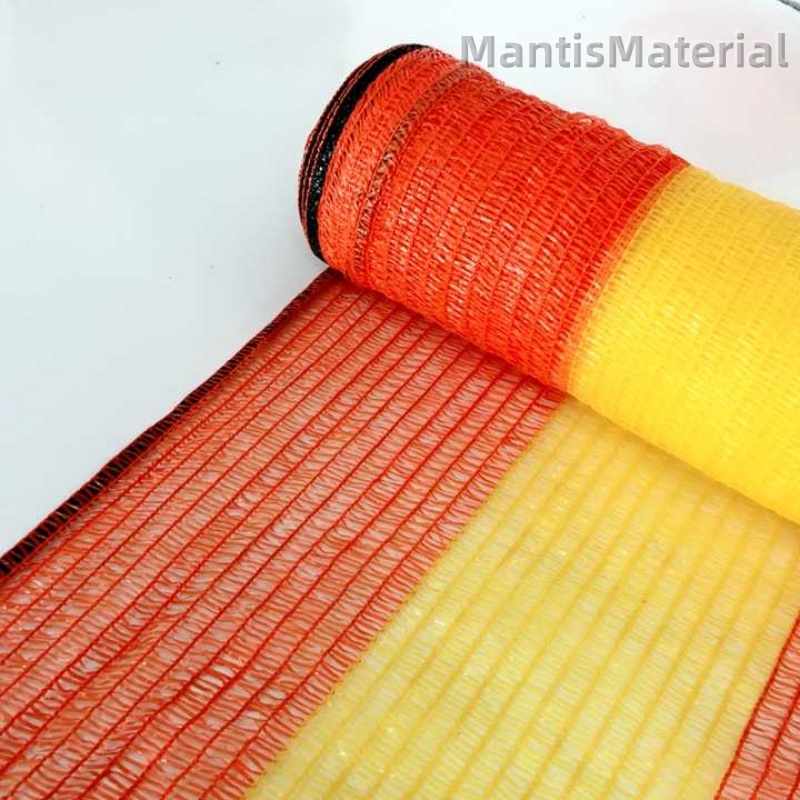
The name comes from the distinctive color pattern—a bright orange base with bold yellow bands running across it—that makes it look a bit like the skin of an onion. But there's nothing frivolous about what this mesh actually does. Made from 100% virgin HDPE with UV protection built in, it's engineered to hold up under direct sunlight without becoming brittle or breaking down. That matters because temporary barriers often end up staying in place longer than anyone planned, and the last thing you want is a fence that starts disintegrating after a few weeks of good weather.
What sets onion mesh apart from heavier, more permanent fencing options is its simplicity. The material is lightweight and flexible, which makes it remarkably easy to work with. Top and bottom straps run the full length of the roll, allowing for quick attachment to support posts without the need for specialized tools or hardware. A couple of workers can set up a long stretch of barrier in a fraction of the time it would take to install traditional fencing. And when the job is done, it comes down just as fast, rolls up neatly, and stores away without taking up much space.
The weight range—typically between 40 and 120 grams per square meter—means you can choose the right density for your specific needs. Lighter weights work well for simple visual barriers and pedestrian safety, while heavier options provide more substantial containment for debris and dust. Standard roll sizes include 0.9 meters by 50 meters, 1 meter by 50 meters, and 1.5 meters by 50 meters, but custom dimensions are available if your project calls for something different.
The applications are where this product really shines. On construction sites, it serves as a practical barrier for containing debris, dust, and other materials, keeping work zones organized and safe. For worker and pedestrian safety, it creates a clear visual boundary that says "stay back" without the intimidation of solid walls or heavy barricades. As scaffold netting and enclosure, it provides lightweight coverage that still allows airflow while keeping loose items from falling off the edges. In industrial settings, plant maintenance, and refinery work, it's a go-to solution for short-term guardrails and temporary containment. And because it's so visible—the bright orange with yellow stripes is hard to ignore—it enhances safety simply by being seen.
What I appreciate most about onion mesh is how unpretentious it is. It doesn't pretend to be a permanent solution. It knows exactly what it is: a cost-effective, practical tool for short-term projects that need to get done quickly, safely, and without blowing the budget. It's the kind of product that doesn't demand attention, but when you need a barrier up fast and you need people to see it, there's nothing quite like it. Bright, simple, and reliable—that's onion mesh doing what it does best.
 عربي
عربي Deutsch
 Français
 Italia
 Portugal
 España